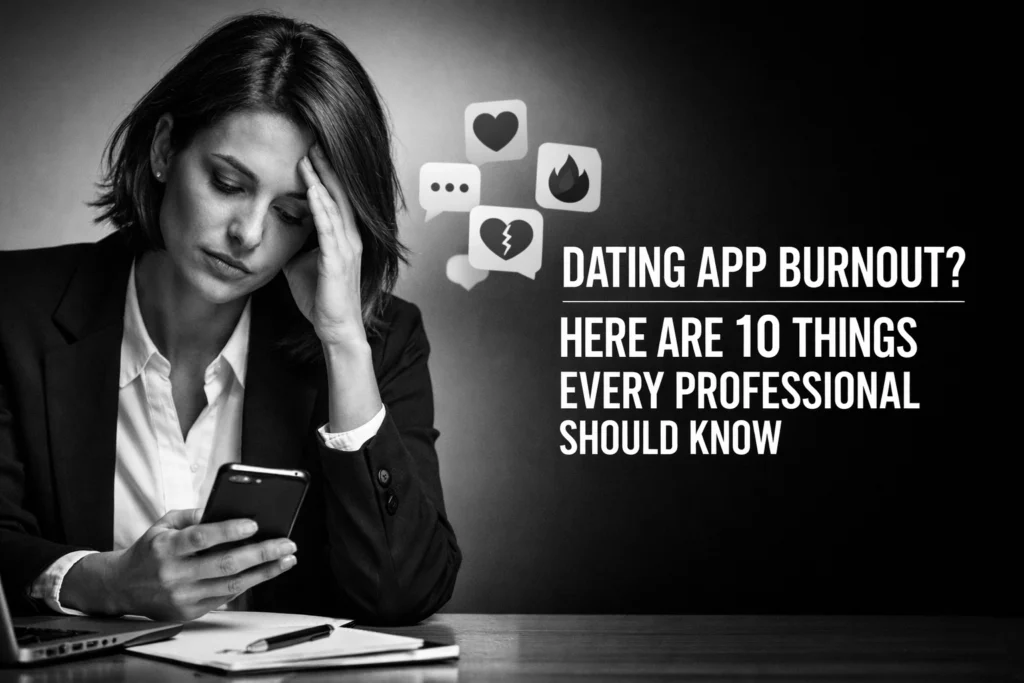
It's 11:47 PM on a Tuesday. You're lying in bed, mindlessly swiping through profiles while half-watching Netflix. Left. Left. Maybe right? Left. You match with someone who seems decent enough, but the thought of crafting yet another opening message makes you want to throw your phone across the room.
Sound familiar?
You're not alone. Recent data shows that 61% of dating app users report feeling overwhelmed and fatigued by the entire process. And if you're a busy professional juggling a demanding career, a social life, the gym, and maybe even a side hustle, that number probably feels low.
Here's the thing: dating app burnout isn't just about being "tired of swiping." It's a legitimate phenomenon that's affecting your mental health, your self-worth, and ironically, your actual ability to connect with someone genuine. And for high-performance professionals who are used to crushing goals and seeing results from effort? The randomness and rejection inherent in app dating can feel particularly brutal.
Let's talk about what's really happening when you're burnt out on dating apps, and more importantly, what you can do about it.

1. Dating App Burnout Is Real (And It Looks Different for Everyone)
First things first: what you're experiencing has a name, and it's not just you being "too picky" or "not trying hard enough."
Dating app burnout manifests in different ways. For some people, it's complete hopelessness about finding a genuine connection. For others, it's the paradox of having 50 matches but zero desire to message any of them. You might find yourself endlessly scrolling without actually engaging, or treating every conversation like a tedious work task you're checking off a list.
Maybe you've started opening the apps out of habit rather than genuine interest. Or perhaps you're experiencing what I call "swipe paralysis", where you stare at a perfectly fine profile and just… can't make a decision.
Here's what matters: if dating apps have started to feel like a second job (one you didn't apply for and definitely aren't getting paid for), you're experiencing burnout. Full stop.
2. Your Self-Worth Is Taking Hits You Might Not Even Realize
Let's talk about something that might sting a little: the more you equate silence on dating apps with personal rejection, the more your self-worth erodes.
Think about it. You send a thoughtful message, crickets. You match with someone who seemed genuinely interested based on their profile, they unmatch after two messages. You go on what you thought was a great first date, ghosted.
And somewhere in your brain, a little voice starts whispering: "What's wrong with me?"
Nothing. The answer is nothing.
But here's the trap: when you're checking apps multiple times a day, experiencing these micro-rejections on repeat, your brain starts to generalize. It's not "that particular person wasn't interested" or "our timing didn't align." It becomes "I'm not attractive enough" or "I'm not interesting enough" or "I'm too [insert insecurity here]."
For professionals who typically excel in other areas of life, this can be especially jarring. You're used to seeing clear correlations between effort and results. Dating apps don't work that way, and that cognitive dissonance is exhausting.
The reality? Most silence on dating apps has nothing to do with you. People get busy, distracted, overwhelmed by their own matches, or realize they're not actually ready to date. But when you're burnt out, your brain doesn't default to these rational explanations, it goes straight to self-blame.
3. Boundaries Aren't Optional, They're Essential
Here's a question: when was the last time you intentionally didn't check your dating apps?
If you can't remember, we need to talk about boundaries.
The "always available" culture of dating apps is designed to keep you engaged (read: scrolling and swiping). But for busy professionals, this creates a toxic dynamic where you're never fully present anywhere. You're checking apps during your lunch break, between meetings, while watching TV, before bed, first thing in the morning…
Sound exhausting? That's because it is.
Effective boundary-setting looks like this:
- Designated "app-free" hours (like before 9 AM and after 9 PM)
- A hard limit on daily swipes (try 20-30 instead of unlimited)
- Specific time windows for checking messages (twice a day max)
- App notifications turned completely off
- One day per week where you don't open them at all
I know what you're thinking: "But what if I miss a great match?" Here's the truth, if someone is genuinely interested and compatible, they'll still be there when you check in during your designated window. The right person isn't going to slip through your fingers because you didn't respond within 47 minutes.
And if you're terrified of implementing these boundaries because the apps have become your primary social outlet? That's a sign you need them more than you think.

4. Passive Swiping Is Killing Your Results (And Your Soul)
Let me paint you a picture: you're lying in bed, swiping through profiles like you're scrolling Instagram. Right if they're attractive, left if they're not, and occasionally you'll pause to read a bio if the photos are really compelling.
You rack up matches. Dozens, maybe hundreds over time. And then… nothing. You don't message them. They don't message you. The matches just sit there, creating this weird digital graveyard of potential connections that never materialize.
This is passive swiping, and it's one of the biggest contributors to burnout.
Here's what research shows: people who actively pursue matches they're genuinely interested in, sending thoughtful, personalized messages rather than relying on passive swiping and waiting, report significantly greater satisfaction and lower burnout rates.
Why? Because you're being intentional. You're making active choices instead of just reacting to a never-ending stream of faces. You're treating the apps like a tool to connect with specific people, not a slot machine you're hoping will eventually pay out.
Try this instead: before you swipe right, ask yourself, "Would I actually send this person a message?" If the answer is no, swipe left. Your time and mental energy are too valuable to collect matches you'll never engage with.
5. You Don't Need to Be on Every Single App
Quick question: how many dating apps are currently on your phone?
If the answer is more than two, you're probably spreading yourself too thin.
I get it. The logic seems sound: more apps = more potential matches = higher chances of finding someone. But what actually happens? You end up maintaining multiple profiles, checking multiple apps, managing multiple conversations across platforms, and feeling like you're drowning in a sea of low-quality connections.
Quality over quantity applies to the apps themselves, not just the people you're matching with.
Instead of being on Hinge, Bumble, Tinder, The League, and whatever other apps you downloaded in a moment of desperation at 2 AM, pick one or two that actually align with what you're looking for. Use the advanced filters. Be specific about your preferences. Treat it like the curated experience it should be, not a numbers game.
For busy professionals especially, this is crucial. You don't have unlimited time to manage five different apps. You need a strategic, focused approach, the same way you'd approach a challenging project at work.
And if you're thinking, "But what if my perfect person is on the one app I'm not using?" Here's the reality: if you're burnt out, overwhelmed, and barely engaging with the apps you're already on, you're not going to connect with that perfect person anyway. Better to be fully present on one platform than half-assing five.
6. In-Person Connections Aren't Dead (And You Need Them)
Here's something that might sound controversial in 2026: dating apps should complement your social life, not replace it.
When was the last time you flirted with someone in real life? Not on an app, actually in person, at a bar, a party, a networking event, the gym, a coffee shop?
If you can't remember, there's a problem.
Dating apps create isolation. They make you feel like you're actively dating when you're actually just… scrolling on your couch in sweatpants. There's no energy exchange, no chemistry test, no opportunity to be charmed by someone's laugh or the way they tell a story.
And for professionals who might already be spending significant time in digital spaces for work, this compounds the burnout. Everything feels transactional, surface-level, exhausting.
Make real-world interactions a priority. Not necessarily with the explicit goal of finding a partner (that energy can be intense), but just to remember what it feels like to connect with humans face-to-face. Join a sports league, attend industry events, say yes to that party invitation, strike up conversations at the dog park.
This does two things: First, it prevents the apps from consuming your entire dating life. Second, it reminds you that you're interesting, charismatic, and capable of connecting with people, something that's easy to forget when you're getting ignored on Bumble.

7. Taking Breaks Doesn't Make You a Quitter
Let me be direct: if you're burnt out, delete the apps. Not forever, just for a week, two weeks, maybe a month.
I know this feels scary. What if you miss out? What if everyone else finds someone while you're taking a break? What if you lose momentum?
But here's what actually happens when you take intentional breaks: you remember who you are outside of the swiping-matching-messaging cycle. You refocus on your values, your interests, what you actually want in a partner. You give your nervous system a chance to reset.
And when you come back (if you decide to), you show up differently. More grounded. More intentional. Less desperate for validation.
This isn't giving up. It's strategic recalibration. It's honoring your emotional well-being instead of pushing through burnout like it's a productivity challenge you can just power through.
Taking breaks without guilt is actually a sign of self-awareness and emotional intelligence, two things that will serve you far better in relationships than any perfectly crafted opening message.
8. Control and Agency Change Everything
Here's a pattern I see constantly with burnt-out daters: they're in reactive mode.
They're waiting for matches to message them. Waiting for conversations to gain momentum. Waiting for dates to be suggested. Waiting for the other person to show interest, make plans, demonstrate consistency.
And all that waiting? It's killing you.
Research shows that users who feel more in control of their dating lives, who actively go after the matches they want instead of passively waiting, experience significantly less burnout.
What does this look like practically?
- You see a match you're genuinely excited about? Message them first, even if you're not "supposed to" on that app
- Conversation is dragging? Ask them out directly instead of endless small talk
- You want a second date? Suggest it. With a specific day and time
- You need clarity on what someone's looking for? Ask
Agency is the antidote to the helplessness that fuels burnout. When you're actively creating the dating experience you want instead of just reacting to whatever comes your way, everything shifts.
Yes, this requires vulnerability. Yes, you might face more explicit rejection. But here's the trade-off: you'll also feel infinitely less powerless, which is worth its weight in gold when you're already burnt out.
9. You're Not Supposed to Figure This Out Alone
Here's something nobody tells you about dating in your 30s and 40s: it's meant to be confusing. The rules have changed. The apps are overwhelming. Everyone has baggage. And unlike your career, where you probably had mentors and professional development, you're supposed to just… figure out dating on your own?
That's absurd.
Sharing your dating experiences with trusted friends, family, or a confidant isn't weak: it's smart. It provides validation, reduces isolation, and helps you maintain perspective when you're spiraling about why someone didn't text back.
But sometimes, you need more than a friend's well-meaning advice. Sometimes, you need someone who actually understands the psychology of modern dating, who can identify your patterns, and who can give you practical coaching tools beyond "just be yourself" and "the right person will come along."
This is where professional support becomes invaluable. If you're experiencing dating-related anxiety, struggling with recurring unhealthy patterns, having difficulty setting boundaries, or feeling completely overwhelmed by app culture, working with a dating coach can transform your entire approach.
At Dating by Richie, we work specifically with busy professionals who are tired of the guessing game. Our Dating Coaching includes personalized sessions that identify your specific blocks and patterns, plus 16/7 SMS support because dating doesn't happen on a schedule. Please note that SMS response times may vary depending on coach availability. We're not here to tell you what to text or how to pose for photos (though we can help with that too). We're here to help you build the emotional intelligence and intentional approach that actually leads to meaningful connections.
And if you're completely burnt out and ready for a total reset? Our Dating Makeover is a 3-day intensive that overhauls your entire dating strategy from the ground up. Think of it like a professional development program, but for your love life.

10. Your Current Approach Isn't Working (And That's Okay)
Let's be honest: if the apps were working for you, you wouldn't be reading this article.
And before you spiral into self-blame, hear me out: it's not that you're doing something fundamentally wrong. It's that the current model of dating apps isn't designed for time-poor, high-performance professionals who need efficiency, depth, and genuine connection.
The swipe-and-match cycle is designed for volume, not quality. It's built on the premise that more options equal better outcomes, when the research actually shows the opposite: decision fatigue, paradox of choice, and lower satisfaction.
For professionals who are used to optimizing processes and seeing ROI on effort, this is particularly frustrating. You're treating the apps like a problem to be solved, when the real issue is that the tool itself might be wrong for what you need.
This is why curated, expert-led approaches change the game. Instead of casting a wide net and hoping something sticks, you get strategic about who you're pursuing, how you're showing up, and what you're actually looking for.
It's the difference between throwing spaghetti at the wall and following a recipe from a chef who's cooked the dish a thousand times.
The Path Forward
Dating app burnout isn't a character flaw or a sign that you're "not ready" for a relationship. It's a natural response to a system that prioritizes engagement over genuine connection, quantity over quality, and endless options over intentional choice.
You're allowed to be tired. You're allowed to take breaks. You're allowed to admit that the current approach isn't working and try something different.
The professionals who succeed in dating aren't the ones who swipe the most or have the perfect profiles. They're the ones who bring the same intentionality, self-awareness, and strategic thinking to their dating lives that they bring to their careers.
They set boundaries. They know their worth. They're selective about where they invest their energy. And when they need support, they're not too proud to ask for it.
If you're ready to move beyond burnout and actually build the dating life you want, start here. Because you didn't build your career by accident, and you don't have to figure out dating by accident either.
Your future partner is out there. But first, you need to show up as the best version of yourself: not the burnt-out, swiping-on-autopilot version. And that starts with acknowledging where you are, being honest about what's not working, and being willing to do something different.
You've got this. And if you don't feel like you do? That's exactly what we're here for.
Disclaimer: Individual results may vary based on personal commitment and background. This coaching and advice is not a substitute for professional therapy, medical, or legal advice. Reading this blog does not create a formal coach-client relationship. All strategies mentioned are to be used at your own risk.