When finding love becomes a second job, it’s time to reconsider your approach
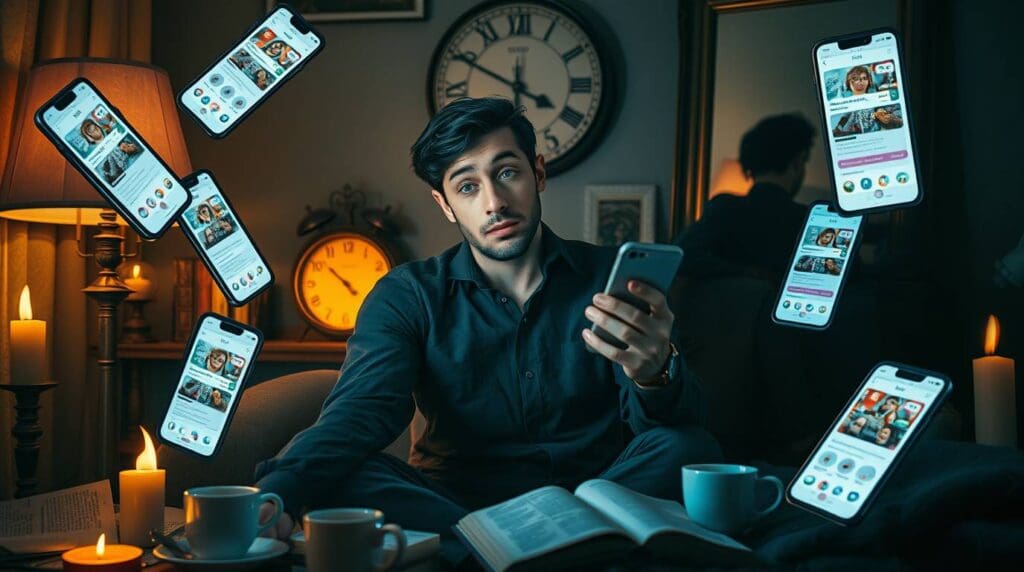
Sarah stares at her phone screen, thumb hovering over yet another profile. It’s 11:47 PM on a Tuesday, and she’s been swiping for the past hour while Netflix plays unwatched in the background. Tomorrow she has three different conversations to maintain, two potential coffee dates to coordinate, and a growing sense that she’s trapped in a digital hamster wheel of romantic possibility that never quite materialises into anything real.
Sound familiar? Sarah’s experience reflects a growing phenomenon that millions of online daters face: the transformation of finding love from a natural, serendipitous process into what feels increasingly like unpaid labour. Welcome to the world of dating app fatigue, where the promise of efficient matchmaking has morphed into an energy-draining cycle that leaves many questioning whether the juice is worth the squeeze.
The Math of Modern Romance
Let’s break down what the average dating app user actually invests in their search for connection. According to recent data, active dating app users spend approximately 90 minutes per day across various platforms. That’s 10.5 hours per week – more than a part-time job. But the time commitment extends far beyond just swiping.
Consider the full cycle: crafting and optimising profiles, selecting and editing photos, swiping through potential matches, engaging in initial conversations, maintaining ongoing chats with multiple people, coordinating schedules for dates, preparing for those dates, and actually going on them. When you factor in travel time and the post-date analysis that inevitably follows, many active daters are investing 15-20 hours per week in their romantic pursuits.
The return on investment? Most users report that fewer than 5% of their matches lead to meaningful conversations, and less than 1% result in relationships lasting more than a few months. By traditional business metrics, dating apps would be considered wildly inefficient systems with dismal conversion rates.
The Paradox of Choice Overload
Dating apps promise abundance, but abundance can be paralysing. When psychologist Barry Schwartz wrote “The Paradox of Choice,” he identified how having too many options can lead to decision paralysis, decreased satisfaction, and increased regret. Dating apps have weaponised this psychological principle, presenting users with what appears to be endless streams of potential partners.
This abundance creates several psychological traps. First, there’s the “grass is greener” syndrome, where users constantly wonder if someone better is just one swipe away. Even when they connect with someone interesting, the knowledge that hundreds of other profiles await can prevent them from fully investing in getting to know that person.
Second, choice overload leads to what researchers call “satisficing” versus “maximising” behaviour. Instead of taking time to thoroughly evaluate potential matches, users develop rapid-fire decision-making patterns based on increasingly superficial criteria. The result is a shallow approach to what should be a deep, meaningful process.
The Emotional Labour Hidden in Plain Sight
Beyond the visible time investment lies a less obvious but equally draining cost: emotional labour. Every interaction on a dating app requires emotional energy. Users must present their most attractive, interesting, and positive selves while simultaneously evaluating others and managing their own expectations and disappointments.
The constant need to be “on” is exhausting. Dating app conversations require a particular kind of performance – witty enough to stand out, but not trying too hard; interested but not desperate; authentic but strategically curated. Users report feeling like they’re constantly auditioning, which transforms what should be natural relationship building into a series of calculated presentations.
Then there’s the emotional whiplash of the process. The brief high of a new match is quickly followed by the anxiety of crafting the perfect opening message. A great conversation can suddenly go cold without explanation. Plans that seemed solid can evaporate at the last minute. Each cycle of hope and disappointment chips away at emotional reserves.
The Gamification Trap
Dating apps have borrowed heavily from the gaming industry, implementing features designed to maximise engagement rather than successful matching. The swipe mechanism itself is based on variable ratio reinforcement schedules – the same psychological principle that makes slot machines addictive.
Push notifications create artificial urgency around matches and messages. Premium features promise better results if you just invest a little more money. Daily limits on free swipes create scarcity that drives users to return repeatedly. These design elements serve the app’s business model but often work against users’ wellbeing and actual dating success.
The gamification extends to user behaviour as well. Many people develop “swiping habits” that have little to do with genuine attraction or compatibility. They swipe while commuting, during commercial breaks, or as a way to procrastinate on other tasks. The app becomes a mindless time-filler rather than an intentional tool for meeting people.
The Conversation Treadmill
One of the most draining aspects of app dating is maintaining multiple conversations simultaneously. Users often feel obligated to keep several potential connections active, leading to what feels like a customer service job where you’re the product being sold.
These parallel conversations require significant mental energy. You must remember details about different people, maintain distinct conversation threads, and somehow keep each interaction feeling fresh and personal. The result is often generic small talk that satisfies no one and builds connection with nobody.
Many users describe feeling like they’re running on a social treadmill, working hard to maintain conversations that seem to go nowhere. The low-stakes nature of app connections means people often put in minimal effort, leading to exchanges that feel more like going through motions than genuine attempts at connection.
The Date Preparation and Recovery Cycle
Each potential date represents a significant time and energy investment that extends well beyond the actual meeting. There’s the coordination phase (finding mutually convenient times and locations), the preparation phase (choosing outfits, grooming, travel), the date itself, and the post-date processing.
Even casual coffee dates can easily consume 3-4 hours when you factor in preparation and travel time. When most first dates don’t lead to second dates, this time investment rarely pays off in terms of relationship building. Yet users feel compelled to continue investing in each opportunity, hoping the next one will be different.
The emotional recovery from disappointing dates is also significant. Each unsuccessful date isn’t just a loss of time – it’s a small rejection that requires processing and recovery before you can approach the next potential connection with genuine openness.
Breaking the Cycle: Strategies for Sustainable Dating
Recognising the problem is the first step toward solving it. Here are evidence-based strategies for reducing dating app fatigue while actually improving your chances of meaningful connection:
Set Boundaries and Limits: Treat your dating app usage like any other potentially addictive behaviour. Set specific times for swiping and stick to them. Many users find success with a “dating app schedule” – perhaps 20 minutes in the morning and 20 minutes in the evening, with phones in aeroplane mode during these sessions to avoid distracting notifications.
Quality Over Quantity Instead of maintaining conversations with 10 potential matches, focus deeply on 2-3 promising connections. This allows for more meaningful dialogue and reduces the cognitive load of managing multiple conversation threads.
Move Offline Quickly Research shows that couples who meet online and quickly transition to in-person interaction have higher relationship satisfaction than those who engage in extended online communication first. Suggest meeting within the first week of conversation to avoid getting trapped in endless messaging cycles.
Batch Similar Activities Rather than constantly switching between swiping, messaging, and planning dates, batch similar activities. Dedicate specific times to profile review, message responses, and date coordination. This reduces the cognitive switching costs that make app dating feel so draining.
Practice Mindful Dating Approach each interaction with genuine curiosity rather than agenda. Instead of evaluating every person as a potential life partner, simply focus on whether you’d enjoy spending an hour in conversation with them. This reduces pressure and makes the process more enjoyable.
Reclaiming Your Energy
The rise of dating app fatigue reflects a broader cultural shift in how we approach relationships. When we treat dating like a productivity challenge to be optimised, we lose sight of what makes relationships fulfilling: genuine human connection, shared experiences, and emotional vulnerability.
The most successful online daters aren’t those who game the system most effectively, but those who maintain their authentic selves and emotional wellbeing throughout the process. They recognise that finding a compatible partner is inherently unpredictable and can’t be rushed through increased effort or time investment.
If you’re feeling drained by your dating apps, consider this your permission to step back and reassess. The goal isn’t to become more efficient at dating – it’s to create space for genuine connection to develop. Sometimes that means spending less time swiping and more time developing yourself, your friendships, and your offline social connections.
Remember, the right person for you won’t require you to exhaust yourself in the pursuit. They’ll appreciate the authentic, rested version of yourself that emerges when you approach dating from a place of abundance rather than scarcity, and curiosity rather than desperation.
Your time and energy are valuable resources. Invest them wisely, and don’t let the promise of digital efficiency rob you of the joy and spontaneity that make relationships worth pursuing in the first place.
Additional Reading
1. Academic Research on Dating App Burnout (2024)
https://journals.sagepub.com/doi/abs/10.1177/14614448241286788
This is a recent peer-reviewed study titled “Burnt out and still single: Susceptibility to dating app burnout over time” that tracked nearly 500 dating app users over 12 weeks. The research showed that dating app users experienced increased emotional exhaustion and inefficacy over time.
2. Comprehensive Mental Health Review (2024)
https://www.sciencedirect.com/science/article/pii/S0747563224003832
This systematic review published in November 2024 examined dating apps’ relationship with mental health and wellbeing. Over 85% of studies reported a significant negative impact of dating app use on body image, and 48.6% of studies reported significant negative impacts on mental health and wellbeing.
3. Forbes Health Study Statistics (2024)
https://happiful.com/got-dating-app-fatigue-heres-how-to-stay-open-to-love-without-burning-out
This article references a major 2024 Forbes Health study with compelling statistics. According to the study, 78% of users say they feel “emotionally, mentally, or physically exhausted” by dating apps.