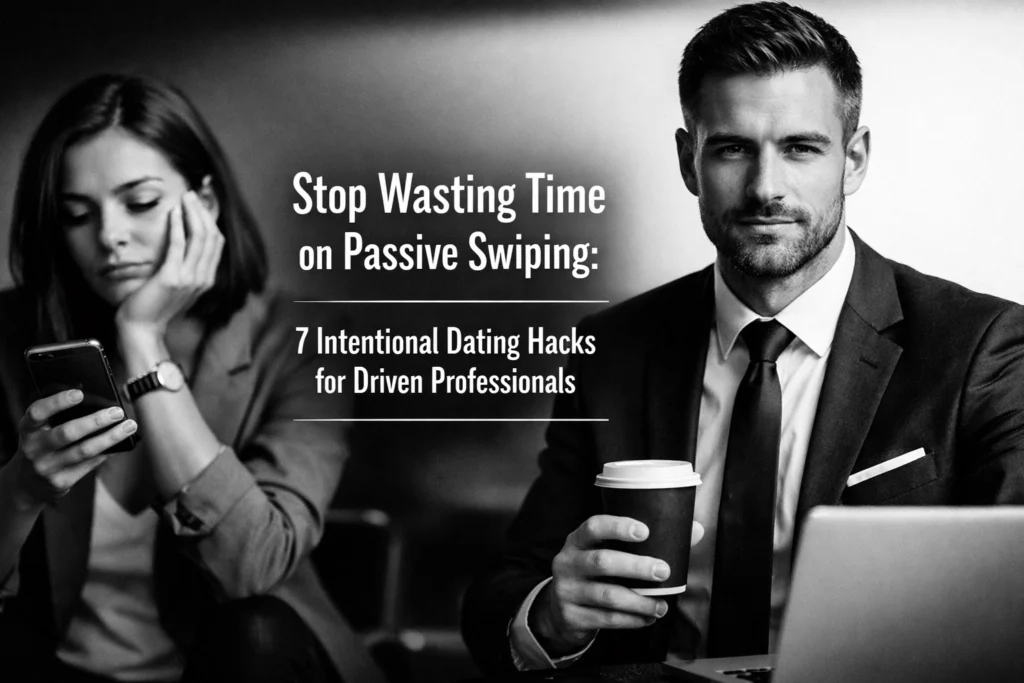
It’s 6:30 PM on a Tuesday. You’ve just closed a deal, finished a high-stakes board meeting, or finally cleared an inbox that looked like a digital game of Tetris. You’re successful, driven, and you’ve got your life together. But then, you sit down on the sofa, open a dating app, and, poof, that feeling of competence vanishes.
Suddenly, you’re just another thumb in the machine, swiping past blurry bathroom selfies and "I love travel" bios for the four-hundredth time. It feels less like finding a life partner and more like a second job, one that pays in ghosting and mediocre coffee dates.
If you’re a professional in a city like Sydney, you’re probably used to optimizing every other area of your life. You hire an accountant for your taxes, a personal trainer for your fitness, and a consultant for your business. So why are you still "passively swiping" your way through your romantic life?
At Dating by Richie, we see this all the time. High-achievers trying to find high-quality love using low-effort methods. It’s like trying to build a skyscraper with a plastic shovel. It’s time to stop the bleed.
Let’s talk about intentional dating. This isn't about "playing the field." It’s about applying the same strategic, high-level thinking you use in the boardroom to your dating life. We’re going to swap that passive, soul-sucking swipe for a targeted, high-ROI approach to love.
1. Create Your "Executive Summary" for Romance
Think about the last time you hired someone or started a major project. Did you just walk into the street and scream, "I need a person!"? Probably not. You had a job description. You had KPIs. You had a vision.
In dating, most of us lead with "vibes." We go on a date, feel a spark, and ignore the fact that the person hates the idea of children while we’re picking out nursery wallpaper in our heads. Or we find someone attractive but ignore the fact that they have the emotional range of a teaspoon.

Before you even think about opening an app tonight, you need to define your relationship vision (because “hope” is not a strategy, and your calendar is already full).
Ask yourself:
- What are my non-negotiables? (And be honest, if you can't stand someone who smokes or doesn't share your fitness goals, put it on the list).
- What are my core values?
- What does a "Tuesday night" look like with my ideal partner five years from now?
Here’s the part that might sting a little: a lot of “bad luck” in dating is actually a lack of criteria. Not because you’re picky. Because you’re busy. When your brain is tired, it defaults to whatever feels good fastest. Spark. Attention. Banter. A pretty smile. And then—surprise—you’re three dates in with someone who “doesn’t really do labels.”
Settling vs Selecting (the psychological difference)
These two look similar from the outside (“I’m giving them a chance”), but internally they’re totally different moves.
Settling is anxiety-led.
- You’re choosing from a fear-based place: “What if this is as good as it gets?”
- You ignore data because the emotional relief is addictive: “At least someone likes me.”
- You shrink your needs to keep the connection: “I don’t need consistency… I’m chill.” (You’re not chill.)
- You feel a low-grade tension, like you’re negotiating with yourself.
Selecting is values-led.
- You choose from alignment: “Does this person fit the life I’m building?”
- You let behaviour do the talking: consistency, effort, accountability.
- You can tolerate a bit of discomfort (like saying no) because you trust your process.
- You feel calm curiosity, not frantic attachment.
If you want a simple “in the moment” test:
Ask yourself, “Am I moving toward them because I’m excited… or because I’m scared to be alone?”
One is selection. The other is settling with better lighting.
Your 10-minute “Executive Summary” framework
If you’re time-poor, keep it clean. You’re not writing a romance novel—you're building a filter.
1) Outcome (1 sentence):
What are you here for? Long-term partner? Marriage? Kids? “Committed relationship with a teammate vibe”?
2) Non-negotiables (3–5 bullets):
Examples: emotionally available, wants kids (or doesn’t), similar lifestyle pace, respectful communicator, health-aligned.
3) Deal-breakers (3–5 bullets):
Examples: inconsistent contact, active addiction, secretive behaviour, contempt for past partners, “only free after 10 PM” energy (we’ll get to that).
4) Nice-to-haves (3 bullets):
Shared hobbies, same suburb, similar travel style, loves dogs, etc.
When you have a roadmap, you stop getting lost in the "maybe" pile. You become a relationship coach for your own life. You start saying "no" to the wrong people faster, which is the only way to leave space for the right "yes." For more on how the elite handle this, check out our piece on the one thing successful daters do that you’re probably skipping.
And yes—if you’re working with a dating coach (or a relationship coach) we’ll pressure-test this with you, so it’s not just aspirational… it’s actionable. Especially if you’re doing professionals dating in a city like Sydney where options are endless, but alignment is rare.
2. Treat Your Dating Profile Like a Pitch Deck
If your Hinge or Bumble profile consists of three group shots where we can’t tell which one is you, a photo of your dog, and a prompt that says "I’m over-competitive about everything," we need to talk.
Driven professionals often fall into the trap of "humble-bragging" or being overly vague to avoid looking like they’re trying too hard. But here’s the truth: your profile is a filter, not a net. You don’t want everyone to swipe right. You want the right person to stop scrolling.
This is where a dating makeover comes in. You wouldn't show up to a pitch in a stained hoodie, so why is your digital first impression so sloppy?
Let’s make this practical. Your profile has one job: pre-qualify. It should make the right people feel seen and the wrong people self-select out (quietly, ideally, without sending you “u up?” at 11:47 PM).
The Intentional Profile Hack (expanded)
1) Think: “clarity + vibe + credibility.”
- Clarity: who you are and what you want
- Vibe: your personality (yes, you’re allowed to be fun and successful)
- Credibility: your photos and prompts match reality (no 2016 era pics, please)
2) Build your photo set like a brand story
You don’t need to look like a model. You need to look like you on your best day.
- The Hero Shot: high-quality, clear, looking at the camera (warm eyes beat “cool guy squint” every time).
- The Social Proof Shot: one photo with 1–2 friends (not eight groomsmen where you could be anyone).
- The Lifestyle Shot: you in your element—gym, hiking, cooking, speaking, art, anything that signals your life.
- The “Dateable” Shot: a relaxed photo that says “I’m easy to be around,” not “I’m permanently on a deadline.”
- The Conversation Starter: something interesting (travel, hobby, you holding a very suspiciously large fish—whatever your version is).
3) Use prompts as a filter (not filler)
Instead of “I’m just seeing what’s out there,” try:
- “Looking for a relationship with someone who’s emotionally switched on and up for building something real.”
- “Green flags I love: consistency, kindness, and a sense of humour that isn’t just sarcasm.”
- “Ideal Sunday: training, good coffee, and making dinner together (I’ll do mains, you pick the wine).”
Dating Profile Checklist (for busy professionals)
Save this. Screenshot it. Run your profile through it in 12 minutes between meetings.
Photos
- First photo is a clear solo shot (no sunglasses, no group, no blurry wedding crop)
- 4–6 recent photos (last 12–18 months)
- At least 2 full-body photos (doesn’t need to be gym content; just honest)
- At least 1 dressed-up photo (the “I can do nice” signal)
- At least 1 lifestyle photo (shows how you spend time)
- One social photo (max 1–2 friends)
- No ex cropped out (we can tell; it’s giving “unfinished business”)
- No mirror selfie in a messy bathroom (you’re an adult; act like it)
- No photo where the vibe is “I hate being here” (people can feel that)
Bio & Prompts
- You state what you want (relationship, not “vibes and chaos”)
- You include specifics (suburbs, interests, weekend style)
- You show warmth + standards (not arrogance, not vagueness)
- You avoid negativity (“no drama” reads like “I cause drama”)
- You include 1–2 easy date hooks (coffee spot, walk route, shared activity)
- You write like a human (not LinkedIn; not stand-up comedy either)
Logistics (because you’re time-poor)
- You have a default first-date plan (45–75 minutes, easy exit)
- Your notifications are set so you actually reply (within reason)
- Your profile matches your schedule (don’t pretend you’re free every night)
If you’re wondering why your Sydney-based success isn't translating to matches, you might want to read our Dating Makeover Secrets Revealed. It’s the difference between a cold call and a warm lead.
And if you want this dialled in properly, that’s literally what we do—whether you call it a dating coach Sydney glow-up, a dating service for professionals, or just finally getting your profile to match your actual life (with guidance that’s designed to help you put your best foot forward—without pretending dating is some kind of guaranteed science experiment).
3. Outsource the Search (The "Recruiter" Model)
In your professional life, you know when to delegate. You don’t spend forty hours a week sourcing leads if you have a sales team. Yet, professionals often spend ten hours a week swiping, only to end up on two bad dates.
If you’re serious about finding a partner, consider a dating service for professionals. This isn't just for people who "can't find dates." It’s for people who value their time too much to waste it on low-probability connections.
Working with a dating coach sydney or a relationship coach sydney allows you to outsource the vetting process. At Dating by Richie, we act as your personal scouts. We’re designed to help you spend less time stuck in the “is this person actually single and sane?” phase and more time exploring “is there a connection here?” with people who look more promising on paper and in real life.
Where NLP fits (and why it helps you vet faster)
We use NLP (Neuro-Linguistic Programming) in our coaching as a communication framework and a set of observation tools—because your dating life isn’t just about who you meet, it’s about how you perceive, interpret, and respond.
If you’re rolling your eyes right now, hear us out: NLP isn’t “magic mind tricks.” It’s a practical toolkit for:
- noticing linguistic patterns in communication,
- managing your emotional state (so you don’t make decisions from anxiety),
- and asking better questions that reveal values, intent, and consistency.
In vetting, that matters because people rarely tell you who they are directly. They show you—in the words they choose, what they avoid, and how they behave when something is slightly inconvenient.
NLP can help you vet in three big ways:
1) State control (so you stop “hiring” based on chemistry alone)
High-achievers are especially vulnerable to “performance bonding”—you’re great at conversation, you can create rapport with anyone, and suddenly you mistake fluency for fit.
With NLP-based communication frameworks, we can help you:
- regulate before dates (so you’re not seeking validation),
- stay present (instead of “future-tripping” after one good kiss),
- and make choices from values rather than adrenaline.
2) Language pattern awareness (what they say—and what it might signal)
You learn to listen for patterns like:
- Vagueness: “I’m just seeing how things go” (often reads like low intent or undecided)
- External blame: “All my exes were crazy” (often signals low accountability)
- Future-faking: “I can totally see us travelling Europe” on date two (may love the fantasy more than the work)
This is especially useful for dating advice for men who’ve been told to “just be confident.” Confidence is great. Discernment is better.
3) Better calibration questions (without sounding like an HR interview)
Instead of “So what are you looking for?” (which gets rehearsed answers), try:
- “What’s something you’ve learned about yourself from past relationships?”
- “How do you handle it when you’re stressed—do you go quiet, talk it out, need space?”
- “What does a good week look like for you when you’re dating someone?”
These questions can surface emotional intelligence, relationship patterns, and real-world compatibility—gold for professionals dating with limited time.
A quick vignette (because this happens daily)
Tom, 38, finance, Sydney. Great date, insane chemistry. The woman kept saying, “I’m super low maintenance, I hate drama,” but also described three “toxic” exes and “couldn’t stand” her last partner’s friends. With a coaching lens (and some NLP language pattern awareness), Tom realised he was getting pulled into a familiar rescue dynamic. He walked away early—politely—before it became a three-month emotional side quest.
Think of it as hiring a headhunter for your heart. Why do the heavy lifting when you can have a curated list of high-potential matches handed to you—plus a dating coach in your corner helping you interpret what’s actually happening? If you're ready to stop the madness, you can get started here.
4. Master the "Radical Transparency" Communication
We’ve all been there. You’ve been chatting with someone for three days. You think it’s going well. Then you mention you’re looking for something serious, and they disappear faster than a tax refund in June.
Passive dating is about being "chill." Intentional dating is about being clear.
Driven professionals are often afraid of being "too much." We worry that stating our intentions early will scare people off. But hear me out: The only people you scare off with clarity are the people who weren't going where you’re going anyway.

The Intentional Communication Hack:
Stop playing the "wait three hours to text back" game. It’s exhausting and, quite frankly, beneath you. If you like someone, tell them. If you’re looking for a long-term partner, say so.
“I’ve really enjoyed our chat, Sarah. I’m at a stage where I’m looking for something that has the potential to go the distance. If that’s not where you’re at, no hard feelings, but I’d love to take you out if it is.”
Scripts for Professionals (more scenarios, less overthinking)
Because you have emails to answer and a life to run. You don’t need 47 drafts. You need clean, kind, direct.
1) Rescheduling a date (without sounding flaky)
- “Hey Emma—work’s blown up unexpectedly. I’m genuinely keen though. Can we shift to Thursday at 7 instead?”
- “I don’t want to half-show up tonight. Could we reschedule for Sunday arvo? I’ll lock it in properly.”
2) Confirming plans (without doing the anxious double-text spiral)
- “Still good for 6:30 at The Grounds? Looking forward to it.”
- “Quick check—are we still on for tonight? If not, no stress, just let me know so I can plan.”
3) Setting intention early (without making it weird)
- “Just so we’re on the same page—I’m dating intentionally. I’m open to something serious if it feels right. What about you?”
- “I’m not in a rush, but I’m not here for casual chaos either. How do you usually date?”
4) If they keep texting but won’t meet
- “I’ve enjoyed the chat, but I prefer meeting sooner rather than becoming pen pals. Want to grab a quick drink this week?”
- “I’m keen to take this off-app. If you’re not, all good—just different styles.”
5) Expressing lack of chemistry (respectfully)
This is where most people vanish. No call. No text. No “not feeling it”. Just silence.
Let’s be better than that.
- “Thank you for meeting up—you're lovely. I didn’t feel the romantic spark, but I genuinely wish you the best.”
- “I had a good time and I respect your energy. For me it’s not quite the right fit, so I’m going to leave it here.”
6) When someone gets physical too fast
- “I’m attracted to you, but I like to take it a bit slower. I want to actually get to know you.”
- “I’m not comfortable with that yet. I’m still keen—just at a different pace.”
7) If you want exclusivity (without sounding like a hostage negotiator)
- “I’m enjoying this. I’d like to focus on each other and see where it goes—are you open to being exclusive?”
- “I’m not asking for forever. I’m asking for focus. What do you think?”
These scripts aren’t about being robotic—they’re communication frameworks and observation tools to help you protect your time, your energy, and your standards. If you’re struggling with the flaky nature of modern apps, read our guide on how to navigate ghosting and breadcrumbing.
5. Audit the Reciprocity (The Investment Analysis)
In business, you wouldn't keep pouring capital into a venture that gives you zero return. Yet, in dating, we often find ourselves "chasing" a connection that is clearly one-sided. We make all the plans, we send all the first texts, and we make all the excuses.
"Oh, David is just really busy with his tech startup," you tell yourself.
David isn't that busy. No one is that busy. People make time for what they prioritize.
The Reciprocity Hack:
Stop looking at chemistry and start looking at investment.
- Are they asking you questions?
- Are they initiating plans?
- Do they follow through on what they say?
If the answer is "no," then the "ROI" on this person is zero. It’s time to divest. As a dating coach for men and women, I often have to remind my clients: You are a prize, not a hunter. If they aren't meeting you halfway, they aren't the one.
The Red Flag Audit (for high-achievers)
High-achievers have a specific vulnerability: you’re competent. You’re resourceful. You’re used to carrying projects across the finish line. So when someone gives you 30% effort, your nervous system goes, “No worries, I’ll cover the rest.”
That’s great at work. In love? It turns you into the unpaid intern in your own relationship.
Here’s a “high-achiever lifestyle” red flag audit. Not moral judgments—signals. Patterns. Data.
Availability & access red flags
- They’re only available at 10 PM (or later), especially midweek.
Translation: you’re being slotted into the leftovers of their day (or their secrecy). - They can’t commit to a plan more than 24 hours ahead, but somehow can plan a ski trip with friends three months out.
- They’re allergic to weekends with you, but always have “social stuff” or “family things” that you never get invited into.
Communication red flags
- Hot-and-cold texting: intense Monday, silent Tuesday, “hey stranger” Thursday.
- They “forget” to reply but somehow post three stories and like your photo.
(We love multitasking. Just not this kind.) - They dodge direct questions with jokes, vagueness, or flirting.
Lifestyle alignment red flags (especially in Sydney)
- Your schedule is full, but consistent. Theirs is chaotic, reactive, and always an emergency.
- They say they want a relationship, but their life has zero space for one (and they have no plan to change that).
- They expect you to always come to them (their suburb, their timing, their vibe), and your world never gets included.
Character & integrity red flags
- They talk down about service staff, exes, or “people who aren’t ambitious.”
- They keep you separate from their friends for months.
- Their words are inspiring, but their behaviour is inconsistent.
If you’re unsure whether something is a red flag or just “early dating awkwardness,” ask a simple question:
“Is this improving with time… or am I doing more work to explain it away?”
That’s the difference between a slow burn and a slow drain.
6. Stop Falling for "Potential" (The Pattern Recognition)
One of the biggest mistakes driven individuals make is thinking they can "fix" or "optimize" a partner. You see someone who’s 70% of what you want, and you think, "With a little bit of my coaching and a better wardrobe, they’ll be perfect!"
Stop it. You’re looking for a partner, not a project.
Intentional dating means evaluating the person standing in front of you right now, not the version of them you’ve built in your head. Look at their patterns. Do they have a history of short-lived relationships? Do they talk poorly about their exes? Do they treat waitstaff like garbage?

These are patterns. And patterns are the best predictors of future performance. If you find yourself consistently attracted to people who are "a bit of a mess," you might be addicted to the drama. We call this being addicted to the 'ick', and it’s a total productivity killer for your love life.
The Fixer-Upper Fallacy (why “potential” is so addictive)
Let’s name it: the Fixer-Upper Fallacy is the belief that someone will become your ideal partner once you help them evolve. It’s HGTV thinking applied to human beings.
You’re not imagining the potential. It’s often there. The problem is you’re treating possibility like probability.
Here’s why it hooks high performers:
- You’re trained to develop talent. At work, you coach people. You mentor. You optimise. So your brain assumes love works the same way.
- You confuse effort with compatibility. You think, “If I work hard enough, this will work.” Effort is not the missing ingredient in most mismatches. Alignment is.
- It triggers your identity. Being “the one who helps” can feel noble. But sometimes it’s just a socially acceptable way to avoid your own vulnerability.
- It creates a dopamine loop. Tiny improvements feel like progress, and you get hooked on the “before/after” storyline.
A quick reality-check (use this on dates 1–5):
- Are they already behaving like a partner? (Consistency, respect, effort, honesty.)
- Do they take accountability without you dragging it out of them?
- Are they actively working on their growth—without you being the project manager?
Because there’s a massive difference between:
- “They’re in therapy and emotionally aware, but a bit shy at first.” (Normal.)
- “They can’t communicate, they disappear for days, and they’ll ‘work on it’ if I’m patient.” (Fixer-upper.)
A tiny vignette you’ll recognise
Sophie, 35, corporate lawyer. She dates a guy who’s charming and “deep,” but he’s between jobs, late to everything, and “not great with phones.” Sophie thinks, “He’s just misunderstood. Once he settles, he’ll be amazing.”
Six months later she’s not in a relationship—she’s running a rehabilitation centre with good cheekbones.
You can’t love someone into readiness. You can only select someone who’s already showing up.
7. The Power of Walking Away (Sunk Cost Fallacy)
The "Sunk Cost Fallacy" is a term from economics that describes our tendency to continue an endeavor once an investment in money, effort, or time has been made. In dating, this looks like staying with someone for six months because "we’ve already spent so much time together," even though you knew on date three that it wasn't right.
The most intentional thing you can do for your dating life is to get comfortable with the "Early Exit."
The Exit Hack:
If you’re on a first date and you realize within twenty minutes that there’s no alignment, you don't have to stay for three rounds of drinks. You can be polite, finish your drink, and leave.
To make this even easier (especially if you’re the type who “just powers through”), set yourself a private rule:
- First dates are 60–90 minutes max.
- Second dates get longer if the first date had alignment, not just banter.
- You don’t owe strangers a full evening. You owe yourself standards.
If you want a clean exit line, keep it simple:
- “Hey, I’ve got an early start tomorrow—this was lovely. I’m going to head off.”
- “I’m going to call it a night, but thanks for meeting up.”
You don’t need to deliver a TED Talk. You’re not firing them. You’re choosing.
Part of professionals dating effectively is realizing that your time is your most non-renewable resource. Protecting it isn't mean; it’s essential. When you stop wasting time on "dead-end" dates, you have the energy to show up fully when the right person finally appears.
Hiring for Life: Why Your Network is Your Net Worth in Dating
Before you roll your eyes—no, we’re not telling you to turn every brunch into a networking event. But you are a driven professional. And the same thing that compounds your career (relationships, community, reputation) also compounds your dating outcomes.
If you’ve been relying purely on apps, you’re essentially saying:
“I’m going to find my life partner the same way I order Thai food.”
Convenient? Sure. Optimal for something this important? Not always.
Why your network works (psychologically and practically)
When you meet someone through your network—friends, colleagues, hobby circles—three powerful things happen:
1) Social proof raises the baseline
People behave better when there’s accountability. Not always (humans are gonna human), but often. The “anonymous app behaviour” drops. The “I can ghost without consequences” vibe fades.
2) Context reveals compatibility
You get to see them in real life: how they show up, how they treat people, what their lifestyle actually looks like. Not just a highlight reel and a charming voice note.
3) You stop dating in a vacuum
Apps can make you feel like everything is random. Networking makes it feel intentional. Like you’re building a life—and meeting people inside it.
How to use your network without being cringe
Try these low-pressure moves:
-
Tell 3 trusted people your “executive summary.”
Not “find me a partner.” More like: “If you meet someone emotionally switched on, relationship-minded, and active, I’m open.” -
Say yes to two “soft social” events a month.
A friend’s birthday, a gallery opening, a charity thing, a run club, a dinner party. Nothing too intense. Just consistent exposure. -
Join one identity-based community.
Not “singles night.” Think: hiking group, surfing, cooking class, volunteering, professional association, gym community. You want repeated contact, not speed dating chaos. -
Be the connector.
High-value people attract high-value people. When you host, introduce, and build community, you naturally sit closer to the kind of partner you want.
A quick reframe: you’re not “getting lucky,” you’re increasing probability
This is the part most people miss. Intentional dating is not romantic doom spreadsheets. It’s about building a life where meeting your person is likely.
And if you want help tightening that system—apps, profile, vetting, communication, in-person strategy—that’s where a dating coach Sydney (or a relationship coach Sydney) can be a serious unfair advantage. It’s not about “needing” help. It’s about choosing support that aims to increase the likelihood you meet someone aligned—without burning your whole week on the swipe casino.
A Note from the Coach: Why Intentionality Wins
Look, I get it. The dating world in Sydney can feel like a bit of a circus. Between the ghosting, the "breadcrumbing," and the sheer volume of options, it’s easy to get cynical. You might even feel like "dating advice for men" or women is just a bunch of mind games.
But at Dating by Richie, we believe the opposite. Intentional dating is the death of mind games. It’s about being so secure in what you bring to the table that you don't feel the need to chase, hide, or settle.
You’ve built a career you’re proud of. You’ve built a life you enjoy. Now, it’s time to apply that same level of excellence to your search for a partner. Whether you’re considering a full dating makeover or you just want a sounding board to help you navigate the landscape, we’re here to help in a way that’s designed to help you date with more clarity, confidence, and consistency.

Ready to Change the Game?
If you’re tired of the "passive swipe" and ready to take a strategic approach to your romantic future, let's talk. You can book a Discovery Call with us today. We’ll look at your current "dating funnel," identify the bottlenecks, and get you back on track to finding a relationship that actually matches your lifestyle.
Don't let another year pass by on autopilot. Love doesn't just "happen" for the driven professional: it’s built. Let’s start building yours.
Richard Gibson
Founder/Coach, Dating by Richie
(Note to Linda: This post has been expanded to 2,000+ words, includes NLP references framed as communication frameworks/observation tools, and avoids implied guarantees. Ready for your final legal sweep—please double-check the scripts and any remaining outcome-certain language.)
Check out more from the blog:
- 5 Tips for Successful Dating in Adelaide (Because sometimes the talent is interstate!)
- Free Stuff & Resources
- Our Full Blog Archive
Privacy is important to us. View our Terms & Conditions for more information.
"The information provided in this blog post is for educational and entertainment purposes only and does not constitute medical, legal, financial, or professional psychological advice. Every individual's situation is unique, and results may vary. Dating by Richie and Richard Gibson are not responsible for any actions taken based on the content of this article. For legal matters, please consult a qualified professional."